

Chinese has a reputation for being one of the hardest languages in the world. But what if I told you it’s actually easier than French, Spanish, or even English in some ways? This makes the process of Learning chinese more approachable than many think.
Table of Contents
Reason #1: Verbs Don’t Bend in Chinese Grammar
Forget memorizing long conjugation tables. In Chinese, verbs stay the same no matter who’s doing the action.
- I eat → 我吃 (wǒ chī)
- You eat → 你吃 (nǐ chī)
- He eats → 他吃 (tā chī)
That’s it. No endings, no irregulars, no exceptions.
When I first learned English, I struggled for years to remember to add an “s” after he, she, it. French? Even more complicated. Chinese? A total relief.
Reason #2: No Verb Tenses When You Learn Chinese
In English, you need to juggle “I go, I went, I will go.” In French or Spanish? Even worse… endless conjugations!
In Chinese, you just add a time word.
- Yesterday 昨天 (zuótiān) + “I go” = “I went yesterday.”
- Next week 下個星期 (xià gè xīngqí) + “I go” = “I will go next week.”
Want to add nuance? Use a few easy helpers like 要 yào (going to), 會 huì (will), or 過 guò (experience). But compared to languages full of past perfect conditionals and subjunctives? Chinese is refreshingly simple.
Reason #3: No Plurals, No Gender. Chinese Is Simpler Than You Think
One word fits all.
- 書 (shū) = book
- 書 (shū) = books
No “le/la/les,” no masculine/feminine, no plural endings. One less thing to worry about.
Reason #4: Learn Chinese Words Like LEGO Blocks
Chinese vocabulary is logical. Most new words are just combinations of smaller ones. Once you know the basics, you can guess a lot of new words.
- 電 (diàn, electric) + 腦 (nǎo, brain) = 電腦 (diànnǎo, computer)
- 火 (huǒ, fire) + 車 (chē, vehicle) = 火車 (huǒchē, train)
- 手 (shǒu, hand) + 機 (jī, machine) = 手機 (shǒujī, cellphone)
Instead of memorizing endless random words, you can piece meanings together and unlock vocabulary naturally.
Reason #5: Straightforward Chinese Grammar Rules
Chinese grammar is clean and logical. Sentences usually follow a simple subject–verb–object order, like English.
Two golden rules guide most word order:
- Big to small: Year → month → day → hour; country → city → street.
- Cause before effect: 因為⋯⋯所以⋯⋯ (because… therefore), 如果⋯⋯就⋯⋯ (if… then).
It’s predictable, flexible, and far less complicated than languages with verb-second rules (German, looking at you).
Reason #6: Chinese Characters Are Logical (and Beautiful)
Characters may look intimidating, but radicals often tell you something about meaning or sound.
- 水 (shuǐ, water) shows up in liquid words like 河 (hé, river) and 海 (hǎi, sea).
- 木 (mù, wood) appears in foresty words like 森 (sēn, forest) and 林 (lín, woods).
Once you learn the main radicals, characters stop being a mystery and start being a puzzle you can solve.
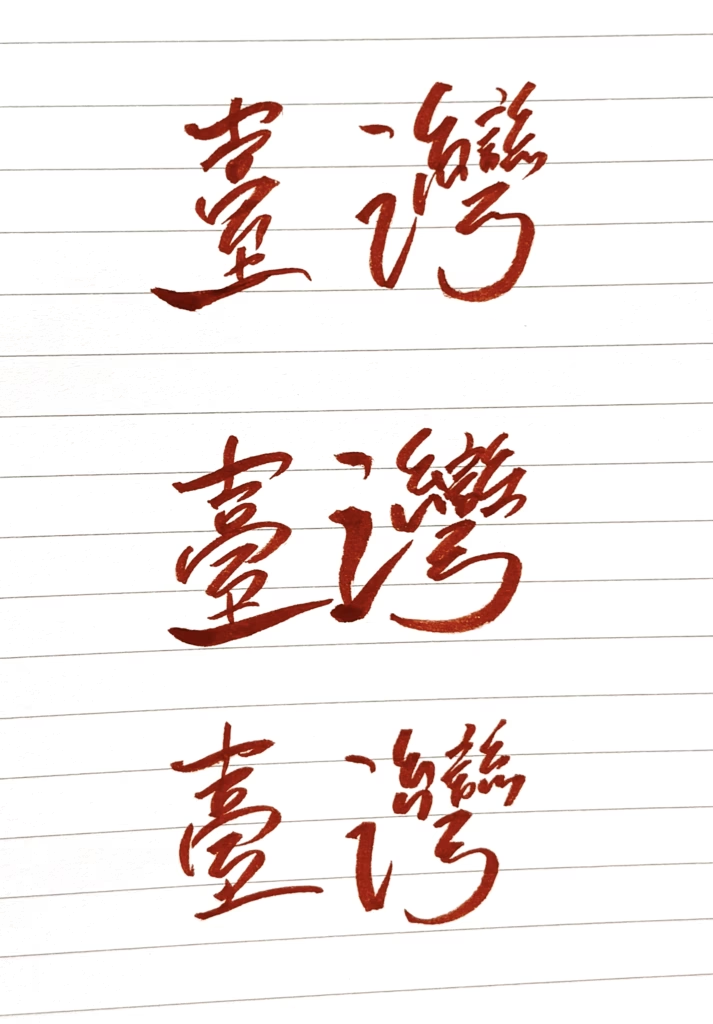
And beyond logic, there’s beauty. Traditional Chinese characters are often described as balanced, almost like tiny works of art. Their symmetry and flowing structure make them satisfying to write and beautiful to look at — which is why they’re still used in Taiwan, Hong Kong, and calligraphy worldwide.
Reason #7: Learning Chinese Is Easier With Patient Native Speakers
You don’t need perfect Chinese to be understood. Chinese grammar is simple enough that even when learners mix up word order or leave out words, they’re still usually understood. Native speakers can follow your meaning with just the key pieces in place.
Say: 我去台北昨天 (wǒ qù Táiběi zuótiān) — literally “I go Taipei yesterday.” Perfect grammar? Not exactly. Understandable? Absolutely.
And here’s the best part: most Chinese speakers are patient and encouraging with learners. Effort goes a long way.
So, Is Chinese Hard?
Sure, Chinese has its challenges: tones, characters, a different writing system. But every language has its tricky parts. When you look past the myths, you’ll find the language surprisingly logical, consistent, and forgiving.
So if you’ve ever thought about learning Chinese, don’t let the “it’s too hard” myth hold you back. Start with the easy parts, and you’ll be amazed at how quickly you make progress.
Ready to see how simple Chinese can be? Start with my Chinese course or tune in to the Mandarin Journey podcast and learn on the go.
Leave a Reply